

We recently published a major update to our Good Clinical Practice (GCP) services, announcing the addition of Indica Labs HALO AI Quantitative Digital Pathology capabilities in the Amazon Web Services (AWS) cloud to support clinical R&D data generation to a regulatory standard.
In this second update, we’ll take a deeper dive into the ‘what, why, and how’ of GCP image analysis and how data generated to a regulatory standard can add value in supporting the progression of therapies to the market.
What is GCP in the context of quantitative digital pathology regulatory data generation?
Good Clinical Practice (GCP) is an internationally recognised ethical and scientific standard for designing, recording, and reporting trials that involve the participation of human subjects.
Studies conducted in accordance with this standard provide assurance that the rights, safety, and well-being of trial subjects are protected and that clinical-trial data are credible (EMA Website).
For quantitative image analysis data to be included in a data package submitted to regulatory authorities, it is essential that it is generated using a workflow that is in accordance with GCP principles and regulatory guidance.
OracleBio can generate quantitative image analysis data to a regulatory standard, allowing you to extract maximum value from your clinical trials. Engaging with you from an early stage, we work with you to devise and support an image analysis strategy to deliver high-quality data to a regulatory standard.
Why is GCP needed and how can it support the progression of therapies to patients?
For therapeutic programme clinical data to be reviewed by regulatory authorities, the data needs to be generated to a regulatory standard.
For quantitative digital pathology data to be performed to the highest quality and able to be included in a data package submitted to regulatory authorities, it is essential that it is generated using a workflow that is in full accordance with GCP principles.
Similarly, for the development of a pathology-focused companion diagnostic algorithm, the quantitative digital pathology data generated to support biomarker signature identification and integration into the algorithm should also be generated to a regulatory standard.
How are GCP studies performed within OracleBio?
As a digital pathology-focused CRO, OracleBio provides image analysis services to support pharma and biotech R&D globally, supporting studies along the R&D pipeline from discovery, pre-clinical, and translational through to clinical. Part of our journey over the past 3 years involved establishing infrastructure and implementing processes to deliver the highest standards of quality to support clinical image analysis data generation to regulatory standards.
Being based in the UK, we abide by the guidelines and principles presented by regulatory agencies represented by the International Council on Harmonisation (ICH) including Europe, the United States, and Japan. Regulatory guideline documents, such as the ICH GCP Guideline ‘Guideline for Good Clinical Practice’ E6(R2), help to form a benchmark from which OracleBio has built its Quality Management Framework (QMF) to align with a quantitative image analysis workflow suitable to support studies performed to GCP.
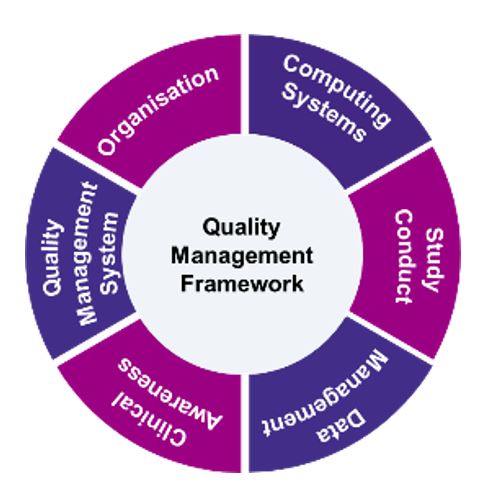
We work from our ‘6 Pillars’ framework:
1 – Organisation
The facilities, working environment, and processes are controlled by standardised policies and procedures. All staff training records, CVs, and job descriptions are managed and updated regularly.
2 – Computing Systems
All GCP dedicated software, servers, and IT equipment are validated. Incident management, disaster recovery, and backups are in place to ensure business continuity.
3 – Study Conduct
Studies are conducted using a managed Image Analysis Workflow. A Clinical Study Manager will be your assigned single point of contact and communicate with you throughout the image analysis workflow.
4 – Data Management
Electronic data is approved and stored within our validated QMS. Where paper copies are required, these are stored within a locked fire-safe cabinet in our offices. We have Data Management and Retention policies in place to ensure we handle your data appropriately.
5 – Clinical Awareness
All OracleBio staff have undergone GCP and HTA training and have an understanding of HTA regulations, requirements, and impact on the actuation of clinical studies.
6 – Quality Management System
OracleBio uses Q-Pulse as a QMS, which allows document control, management of records, and recording of users’ activities, job roles, and associated training logs. The QMS is also utilised for scheduling and recording audits, study management, asset management, and CAPA activities.
Quality Managed Workflow
OracleBio is a dedicated image analysis digital pathology services company with highly skilled experts in quantitative digital pathology, performing image analysis to the highest quality for our valued Clients.
The efficiency of our workflow revolves around critical elements present throughout the study. Key to this is good and effective communication with the Client and continuous attention to quality control and oversight from our quality assurance. Think of us as an extension of your project team.
Our comprehensive workflow for GCP studies principally involves 2 parts; first, the development and validation of algorithm(s) (bespoke or transferred from the Client) and second the analysis of study images using the validated algorithms. The figure below describes the basic steps throughout the process.
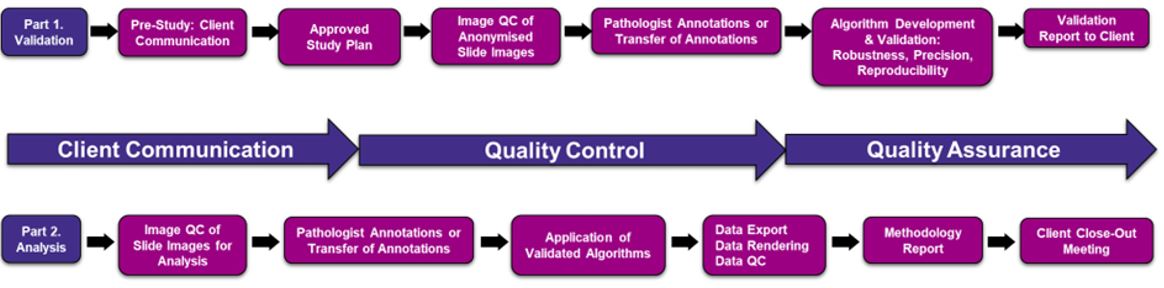
Part 1 requires input, understanding, and communication with and from the Client. From the initial proposal based on the clinical trial tissue being analysed, to the approval of the study plan and establishing a validated algorithm through a series of defined and auditable steps.
Part 2 sees the application of the validated algorithms across the tissue image study set, following an agreed and transparent workflow. Every step of this process involves communication with the Client through continuous review and milestone decisions in the study.
What are OracleBio’s selling points and value adds?
- The OracleBio Quality and Compliance Team has years of combined regulatory experience, supporting numerous projects in regulatory environments including GCP & GLP.
- OracleBio’s clinical pathologists work closely with our image analysis scientists to support tissue annotations, algorithm development, and validation. Furthermore, our workflow and software allow us to work collegiately with client pathologists to support clinical study projects.
- OracleBio uses AI-powered image analysis software to perform analysis for GCP studies. The integration of AI-powered algorithms can improve accuracy around challenging tissue and/or cell segmentation requirements within chromogenic, immunofluorescence single or multiplex staining across morphologically heterogeneous tissue sample images.
- OracleBio’s image analysis platform is located within the high-performance Amazon Web Services (AWS) cloud. The ability to analyse images in the AWS cloud environment provides access to scalable Central Processing Units (CPUs) and Graphics Processing Units (GPUs) on demand – this can significantly improve analysis turn-around time while helping to manage image processing costs.
We are committed to delivering data to the highest quality standard for R&D or to support clinical evaluation and regulatory submission. Your image analysis data may not be required for inclusion in a regulatory submission package, but whether you are working with pre-clinical research models or clinical trial tissue, quality, and confidence in the data you are receiving are paramount, and delivery-assured with OracleBio.
Ready to take your clinical R&D to the next level? Let’s talk about how we can support you.
You can also learn more about our GCP services by downloading our brochure.
How OracleBio can support you
Why work with OracleBio?
Stay up to date with OracleBio
Sign up to our mailing list to stay informed about news, webinars, events and more