
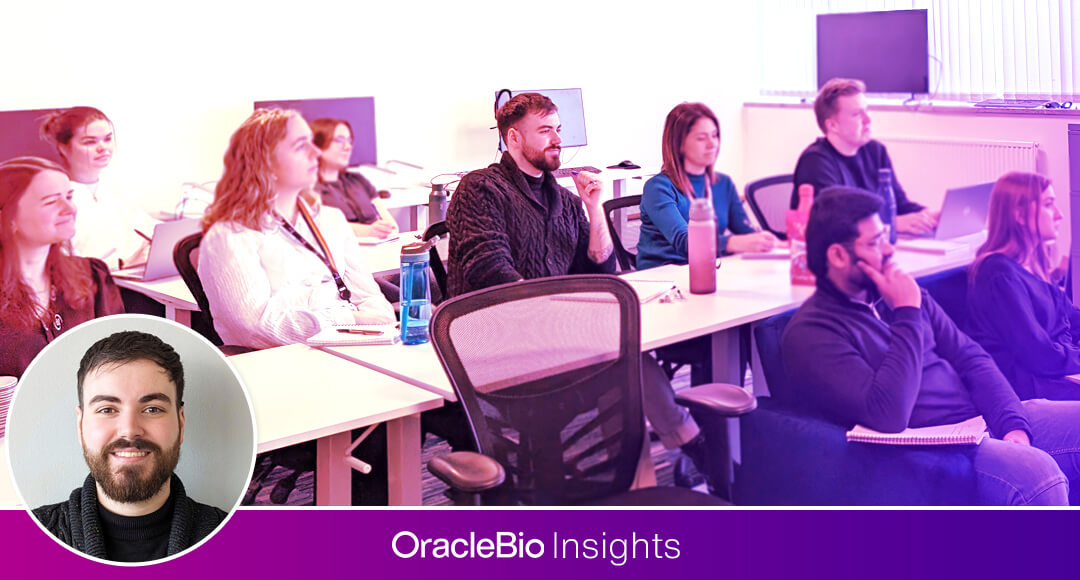
⚡ Article Synopsis: In this article, Image Analyst, Fergus Cunningham, gives an interesting behind-the-scenes look at his journey through OracleBio’s graduate entry programme. Fergus gives an insight into some of the responsibilities that empower our team and how we leverage cutting-edge computer technology to stay ahead in our field. You’ll learn about our training academy programme, our commitment to continuous improvement, and get a glimpse of our image analysis workflow, some of the challenges our scientists overcome, and the supportive environment that fosters their growth.
At OracleBio, we work at the intersection of cutting-edge computer technology and medical research. Leveraging deep learning algorithms and our knowledge of histopathology, we extract actionable data from medical research images for our Pharmaceutical and Biotech Clients.
As Image Analysis Scientists, we follow a series of defined steps to obtain this data, which are collectively known as image analysis workflow. These steps include image quality control (QC), segmentation of regions of interest (ROIs) and objects, such as cell nuclei, using machine learning algorithms, and quantification of object-associated markers within the ROIs.
The dynamic role of an OracleBio Scientist follows this workflow, meticulously quality-checking and annotating tissue sections, developing custom algorithms to partition ROIs, identify cells, and quantify marker expression, and producing informative data packages from the results, all while collaborating closely with Clients.
This article is a reflective journey through my first year as an Image Analyst at OracleBio. It highlights how the comprehensive training programme develops budding scientists into skilled analysts and my thoughts on how the company’s mission and culture help us stay at the cutting edge of quantitative digital pathology.
OracleBio’s Training Programme
The training programme at OracleBio has a modular structure that reflects image analysis workflow. Each module consists of a series of tasks representative of the processes we undertake during a typical client study. Each task brings new challenges, giving trainees the experience to become proficient in working with a diversity of tissue types and stains.
The first module lasts several weeks and focuses on image QC and annotations. It lays a foundation for all our future scientists, teaching us to recognize tissue features and artefacts, align with the team on our approaches, and become comfortable using the annotation tools on the commercially available software we use, such as Indica Labs HALO and Visiopharm.
In subsequent training modules, we develop basic algorithms for tissue classification, cell segmentation, and analysis. Tissue and cell segmentation classifiers are deep learning algorithms that partition tissue into distinct classes based on colour, texture, and shape. The former aims to separate ROIs, such as viable tumours, from stroma, glass, and necrosis; the latter aims to identify cell nuclei against the background. This involves annotating multiple regions that represent the desired output and training the algorithm until it is able to generalize this to the entire image set. Classifiers can then be incorporated into analysis algorithms to quantify cell-associated marker expression within ROIs.
We then move on to QC and annotations on more complex staining assays, such as high-plex immunofluorescent images, and finally, we tackle advanced image analysis algorithm development.
An OracleBio senior scientist reviews each completed task. They give constructive feedback, highlight areas for improvement, and approve the task once any required amendments are made. This ensures that trainees learn the standard procedures adopted by the wider team, establishing consistency and quality. Ultimately, this ensures that OracleBio generates accurate, reliable, and reproducible data.
Once a training module is completed, we progress to contributing to live study work under the continued support of the image analysis team, allowing us to consolidate the knowledge gained from the training. All of our time is initially dedicated to training, with a gradual transition to live study work in parallel with undertaking new modules. This allows us to continue learning on the job, adding new skills to our repertoire, taking on additional responsibilities, and working more autonomously.
Mentorship plays a crucial role in the training programme’s success, with the entire team actively supporting new analysts. A culture of open communication encourages us to seek guidance and clarification on tasks. We also take several sessions with our company’s clinical pathologists, who help us recognize complex patterns we may observe and understand the corresponding biological phenomena.
Throughout this journey, we are encouraged to grow professionally by attending webinars, interacting with clients, presenting what we have learned at company-wide meetings, and building transferrable skills such as critical thinking and problem-solving. These regular interactions with the wider team build a supportive and friendly atmosphere, reinforcing open communication and contributing to an enjoyable work environment.
Continuous Improvement
The ability to adapt to emerging trends and strategies is essential for OracleBio to stay on the cutting edge of this rapidly evolving field, continually improving and streamlining our workflows and providing our clients with a broader suite of services.
One way we foster continuous improvement is through interdisciplinary collaboration. Our weekly company-wide meetings facilitate the sharing of knowledge between different teams, including operations, R&D, and image analysis. These sessions offer a forum for fruitful discussions and provide a platform for disseminating any significant developments to the rest of the group.
We also have weekly study spotlight meetings, allowing us to present the image analysis approach we are taking for ongoing studies. This allows us to become aware of each other’s work and translate these shared learnings to other current and future studies. As we often support each other in various stages of the workflow, a top-level understanding of all ongoing project work is invaluable. This also helps ensure that our analysis methods are harmonized across the whole team.
Finally, our client-centric approach to studies stands out as one of the defining features of OracleBio’s success. Communicating openly and honestly with our Clients ensures that our services and data align closely with the study objectives. Reciprocal insights and feedback from both sides enhance our collaborative relationships, building trust and reinforcing that we serve as an extension of their team.
In Conclusion…
During my time at OracleBio, the training programme has helped me build a solid foundation in digital pathology, which is essential for becoming a proficient image analyst. Through ongoing support from some of the leading experts in our field, trainees such as myself are actively empowered to grow into well-rounded scientists. We are encouraged to be curious and proactive and to continually build our knowledge and skills, which naturally increases our personal development and the contributions we can make to our Clients’ projects.
Moreover, the collaborative environment, the ethos of continuous improvement, and our client-centric approach to how we tackle projects help us stay at the forefront of our field, ensuring that we continue to deliver robust, actionable data and stay ahead in this evolving industry.
As I progress in my role as an Image Analysis Scientist at OracleBio, I am confident that the supportive environment will help me grow and increase the value I can bring to projects. I hope to expand my repertoire of skills, gain confidence in tackling complex studies, contribute to strategies that streamline our workflows, improve the quality of the data we provide, and continue celebrating successes within the team and the company.
How OracleBio can support you
Why work with OracleBio?
Stay up to date with OracleBio
Sign up to our mailing list to stay informed about news, webinars, events and more